
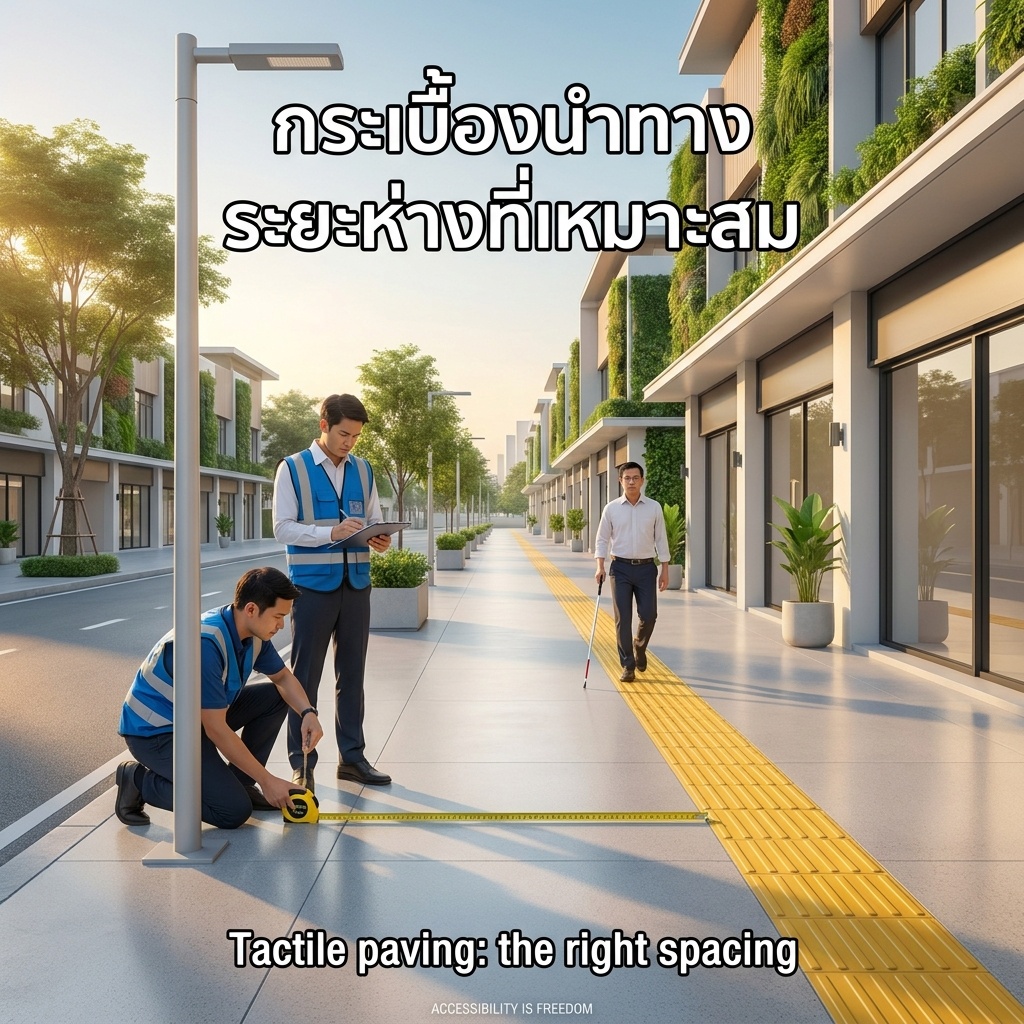
Still on tactile paving. This time: how much clearance does a guide path need so blind people can walk safely?
Know first how blind pedestrians walk. Some straddle the line and tap ahead with their cane. Others walk alongside on their preferred side, brushing the edge with foot or cane to stay oriented. Both styles need a straight, open path. A cane sweep covers about 120 centimeters, so tactile paving spacing from poles and trees must be generous — never squeezed tight as we so often see.
The problem: Thailand’s🇹🇭 sidewalk rules never mention obstacle distance. The 2021 Ministerial Regulation only says guide paths must lead “to building entrances, service points, restrooms, elevators, or stairs.” No width. No distance from trees, poles, or bus stops. Contractors lay lines as they wish — paths skim trunks, charge toward utility poles, zigzag enough to dizzy anyone.
Japan🇯🇵 requires zero obstacles within 30 centimeters around every block, with paths running straight. But 30 centimeters is a bare minimum, too tight. Normal areas need 60 centimeters or more, matching ISO 23599, which sets tactile paving spacing at 60 centimeters. Its core principle: “Tactile paving should not compensate for poor design.” Remove the obstacle — don’t reroute around it.
Clause 3/1 of the 2021 Regulation allows referencing other accepted standards — our opening. Put these numbers into every Terms of Reference (TOR) and strengthen acceptance checklists. Above all: public participation. People with disabilities must sit at every table, from pre-design through construction and handover.
Never forget: blind people can’t see. If we build hazards, they won’t know until they hit them.
The right urban development lets everyone travel safely.
Sources: 2021 Ministerial Regulation; ISO 23599; MLIT Japan