

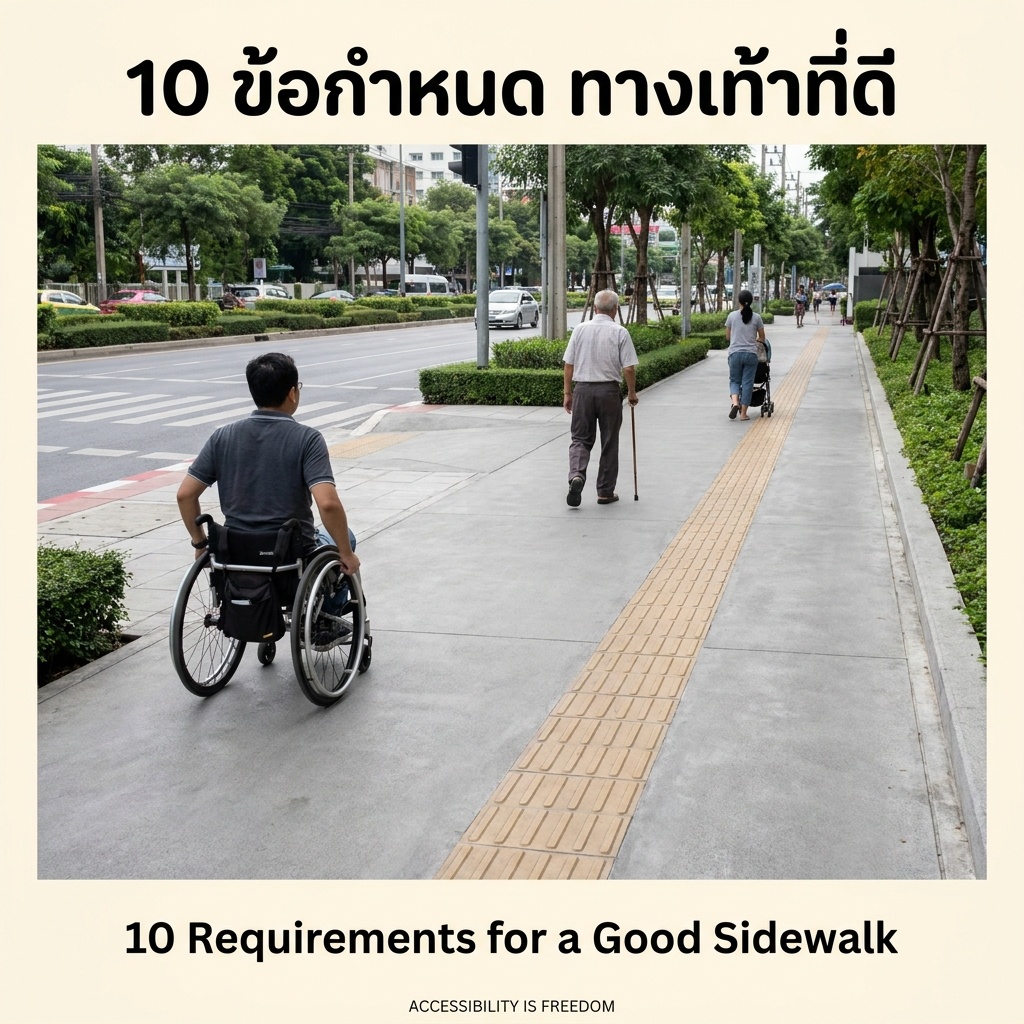
“10 Requirements for a Good Sidewalk”
A good sidewalk should let people travel continuously from start to finish.
Here is a simple 10-point checklist you can use to observe sidewalks around you:
1. The route is continuous from start to finish, without forcing people to step down onto the road.
2. The main walking path has enough clear width, at least about 1.50 meters at points where people need to pass each other.
3. The surface is smooth, strong, stable, and not slippery.
4. There are no holes, pits, cracks, or uneven level changes that could cause people to trip.
5. Manhole covers, grates, joints, and repaired areas must be flush with the surface.
6. There are no poles, signs, plant pots, vendor stalls, or parked vehicles blocking the walking route.
7. There are no hanging signs or tree branches that are too low in the head-clearance zone.
8. If there is a level change, there must be a ramp that can actually be used.
9. Crossings, connection points, and building entrances are connected continuously.
10. People with visual disabilities, wheelchair users, older people, cane users, and people pushing strollers can use it without needing extra assistance.
International standards 🌐 such as the ADA and ISO follow this principle.
Thai law 🇹🇭 also emphasizes the same principle: the Persons with Disabilities Empowerment Act prohibits discrimination against people with disabilities, and the ministerial regulation on accessibility facilities provides reference criteria for accessible walkways, including width, surface, obstacles, and ramps. Everyone should be able to travel conveniently and safely.
Does the sidewalk near your home meet all 10 points?
Sources: DLA, MSDHS, ADA, ISO