
17 February 2003 — Mayor Ken Livingstone launched a policy he predicted would be a “day of bloodshed.” A £5 (approximately 230 baht) charge for vehicles entering central London, covering 21 square kilometres.
Opposition was fierce. Critics coined the nickname “Kengestion charge” — blending Ken’s name with congestion. Westminster City Council took it to the High Court (the court dismissed the case). John Lewis reported a 7.3% sales drop. 25% of businesses threatened to relocate out of the zone.
But results came faster than anyone expected. Day 1: traffic entering the zone dropped 25%. Within 2 weeks, traffic was down 20% from baseline. 300 additional buses were deployed immediately. Travel time fell 14%. In 2004, Livingstone won re-election — Londoners voted to endorse the policy.
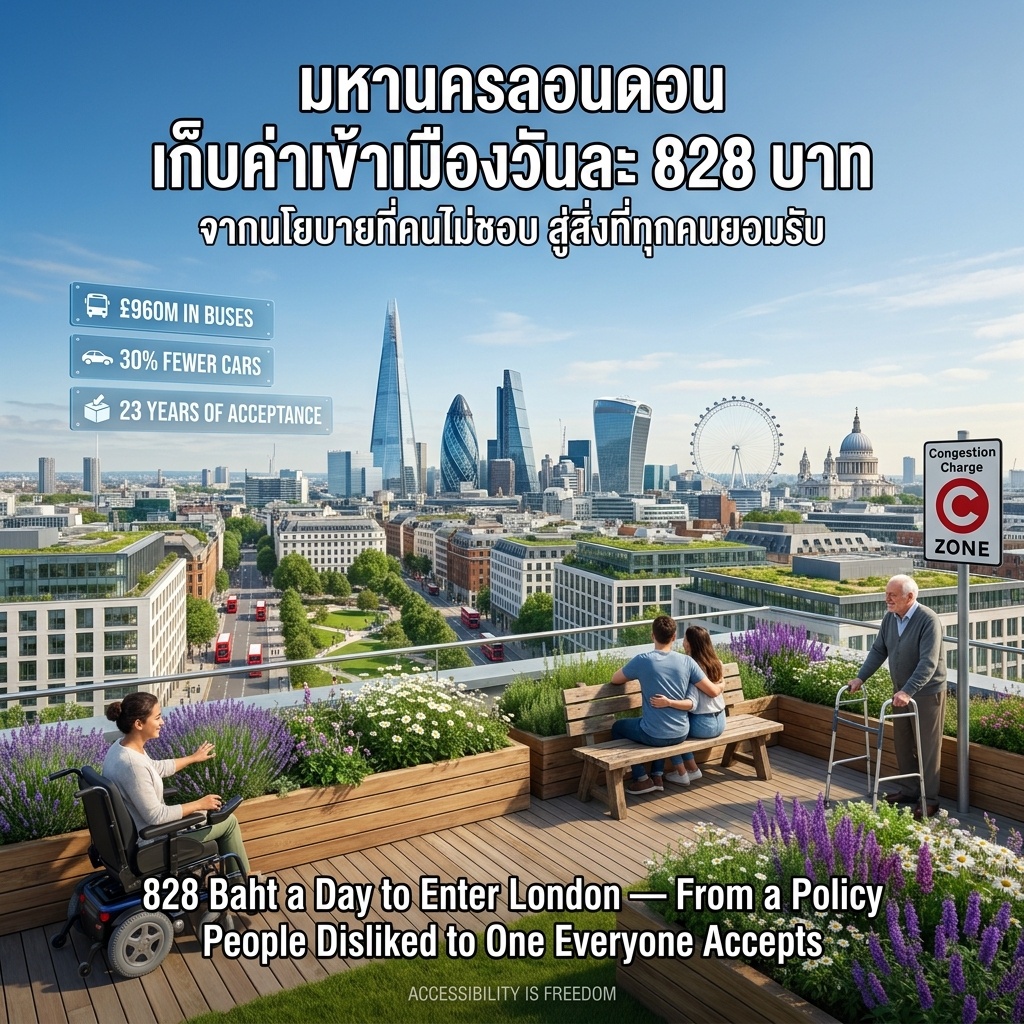
The charge has steadily risen since. Currently £18 (approximately 828 baht) in 2026, enforced Monday–Friday 07:00–18:00 and Saturday–Sunday 12:00–18:00. ANPR cameras read licence plates with 90% accuracy. Blue Badge holders are fully exempt; zone residents receive a 90% discount.
Environmental impact in year one: NOx down 13.4%, PM10 down 15.5%, CO₂ down 16.4%. After 3 cumulative years: NOx down 17.3%, PM10 down 23.8%. Vehicles in central London fell 30% from baseline.
Total revenue reached £2.6 billion (approximately 119.6 billion baht) in the first 10 years, with £960 million (approximately 44.16 billion baht) invested in the bus system and £1.2 billion (approximately 55.2 billion baht) in public transport infrastructure overall. 23 years on — no political party dares touch this policy.
A lesson in meaningful change — and a model for cities everywhere.
Sources: Transport for London, Wikipedia, academic reports