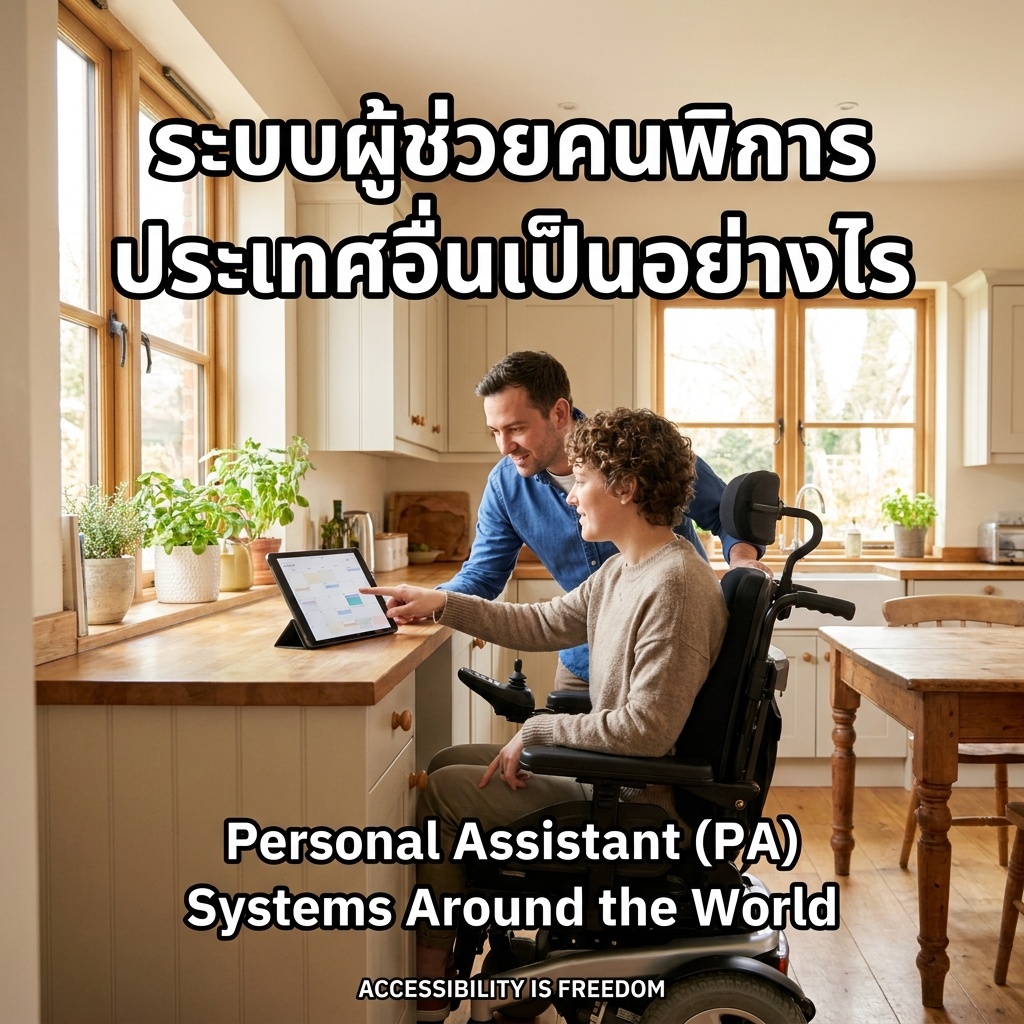
I’ve been hearing a lot of discussion about personal assistants (PAs) and seeing different perspectives exchanged. I got curious—what are other countries doing?
Sweden’s LSS law, in place since 1993, makes personal assistance a legally enforceable right with full government funding. People with disabilities choose and train their own assistants with no certification required. PA is a recognized occupation with union-negotiated wages around SEK 140-160 per hour (about 500-570 baht). About 16,000 people receive state-funded PA, but budget cuts since 2015 have tightened approvals. Family members can be PAs, though restrictions increased in 2023.
Japan has the strictest system. All paid care workers need mandatory certification. An agency-based model puts a care manager in control, not the person with a disability, minimizing consumer direction. Family members in the same household cannot be paid PAs. The system targets older adults; younger people with disabilities are on a separate, less-funded track. Care worker salary is about ¥280,000-320,000 per month (roughly 70,000-80,000 baht). A severe workforce shortage drives reliance on foreign workers from Southeast Asia.
The United States uses the Consumer-Directed model (CDPAP), where the person with a disability hires, trains, and fires their own PA. Family members can be paid. The 1999 Olmstead Supreme Court decision affirmed the right to community living over institutions. But state differences are huge—PA isn’t guaranteed everywhere. Average wage is $13.52 per hour (about 490 baht), most have no benefits, and turnover is high. New York State alone has about 250,000 CDPAP users with a $6 billion annual budget (about 217 billion baht).
All three models show a good PA system must center people with disabilities, not service providers.
Sources: OECD, Wikipedia, Försäkringskassan, MHLW, CMS